
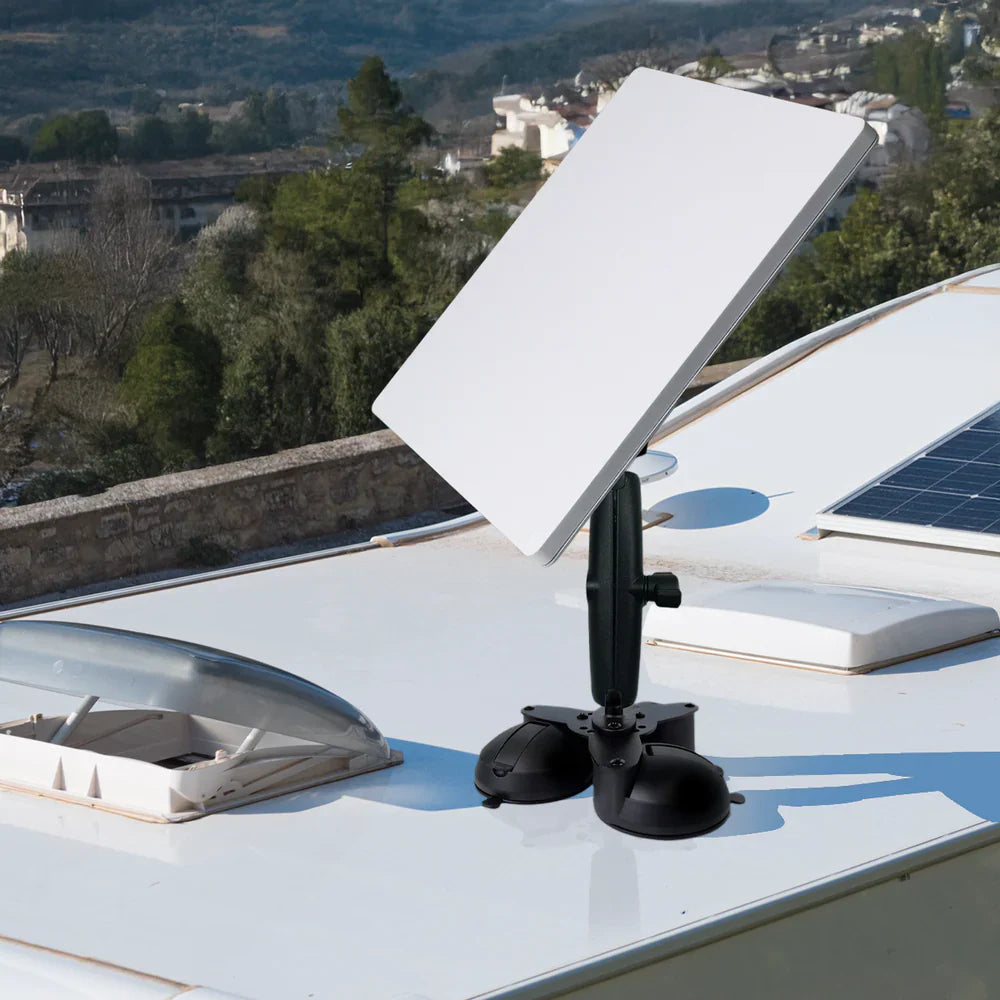
If you live on the road, you already know the two things that make or break a remote workday: power and signal. Starlink Mini solved the signal problem the moment it launched — a satellite dish small enough to live in a glovebox, delivering broadband speeds in places that used to mean zero bars and a dead laptop. But there's a problem nobody tells you about until you're three days into a trip: Starlink Mini is only as good as what it's sitting on.
Set it on the dash and it slides into the footwell the first time you hit a pothole. Prop it against the windshield and a stiff crosswind sends it tumbling off the hood. Balance it on the roof rack and you spend your "connectivity break" chasing it across a gravel lot. None of this is a Starlink problem. It's a mounting problem — and it's exactly what we built Mighty Mount to solve.
Why Vehicle-Based Starlink Setups Fail Without the Right Mount?
Overlanding and van life put a satellite dish through conditions it was never designed to sit through unassisted: washboard roads, sudden braking, steep grades, high winds at elevation, and constant vibration from tires that rarely touch pavement. A flimsy mount — or no mount at all — means one of three outcomes: the dish shifts out of its optimal sky view and your connection drops, the mount itself fails and the dish hits the ground, or you're stopping every hour to readjust something that should have stayed put the first time.
For a mobile setup, three things matter more than anything else:
-
Vibration resistance. The mount has to absorb the constant micro-shocks of rough terrain without loosening.
-
Weight distribution. A single point of contact concentrates stress and increases the chance of slippage. Multiple points spread the load.
-
Fast, tool-free installation. You're not carrying a toolbox to reposition your internet every time you relocate camp.
The Triple Suction Mount: Built for Exactly This
Our Triple Suction Mount exists because van lifers and overlanders kept asking for the same thing: a mount that behaves like it's bolted down, without actually requiring a drill. The three-point suction system is the core of what makes it work. Instead of relying on one suction cup to fight gravity, vibration, and wind resistance all at once, the load is distributed across three points of contact. That distribution is what keeps the dish locked in position on windshields, rear windows, and other glass surfaces — even when you're grinding down a fire road at 20 mph with the suspension working overtime.

This matters more than it sounds. A single-cup suction mount might hold fine on a smooth highway, but introduce the kind of terrain overlanders actually drive on and that single point becomes a pivot. The dish tilts, the signal degrades, and eventually the whole thing lets go. Triple-point contact resists that pivoting motion, which is exactly why it's become the go-to choice for mobile internet setups where the vehicle itself is the variable you can't control.
Real-World Use Cases
-
Van life full-timers running Starlink as their primary internet connection need something that can stay mounted through an entire multi-week loop without babysitting it. The triple suction setup means you mount it once at the start of a leg and don't think about it again until you're parked.
-
Overlanding trips into terrain with no cell coverage depend on Starlink Mini being functional the moment you stop — not after twenty minutes of fiddling with alignment. A stable mount means the dish holds its sky-facing position through the drive, so it's already oriented correctly when you park.
-
Remote field work — surveyors, researchers, film crews, disaster response teams — all share the same requirement: connectivity that survives a rough commute to the job site. A mount that holds through vibration isn't a nice-to-have here, it's the difference between a functioning workday and a wasted one.
What to Look for Beyond Suction Points
A good mount isn't just about staying attached — it's about staying attached correctly. That means:
-
A design that keeps the dish's sky view unobstructed, since Starlink needs a clear view of the horizon to maintain connection quality.
-
Materials that won't degrade under UV exposure and temperature swings, since a mount baking on a dashboard in Arizona sun faces a very different stress test than one used for a weekend trip.
-
A release mechanism you can operate one-handed, because most people are adjusting mounts while also holding a coffee, a dog leash, or a fussy toddler.
The triple suction mount checks all three. It holds its position without obstructing the dish's field of view, it's built to handle sustained outdoor exposure, and it releases cleanly when you're ready to pack up and move on.
The Case for Investing in a Proper Mount
It's tempting to treat mounting as an afterthought — Starlink is the expensive part, right? But a $600+ satellite terminal sitting loose on a dashboard is a liability, not a setup. One hard stop, one missed pothole, and you're looking at a cracked case or a dish rolling into traffic. A mount is cheap insurance against a very expensive mistake, and it's the difference between "internet that works when the van is parked just right" and "internet that works, period."
If you're building out a van life rig or prepping for your next overlanding season, start with the mount. Everything else about your connectivity setup depends on the dish actually staying where you put it.